2015年5月11日

5 Unexpected Signs That You're Depressed

Posted: Updated:
ou're not sad or overwhelmed, but maybe stuff has nonetheless gotten to you. Here are overlooked signals that you might need a little support to get back to feeling better, happier and more yourself.By Jessica Migala
You're super-fidgety.
The term "depressed" makes most of us think of someone who is low. Lagging in energy. Sleeping a lot. Generally feeling "blah." "There are actually two different types of depression," says Julie Holland, MD, the author of Moody Bitches: The Truth About the Drugs You're Taking, the Sleep You're Missing, the Sex You're Not Having, and What's Really Making You Crazy. The second, less well-known type, is feeling agitated and uptight. "You don't sleep well, you're pacing a lot, you're fidgety." That's why, Holland says, depression experts tell patients to watch out for changes in sleep and energy patterns, not just if you're feeling blue and dragging.
You're inexplicably achy.
woman ache
Keeping emotions bottled up means they erupt somewhere -- sometimes as bursts of anger, but other times manifesting as physical symptoms like headaches, chronic pain and stomach aches, says Adria Pearson, PhD, a faculty member at the University of Colorado Anschutz Medical Campus Depression Center. But that doesn't mean it’s "all in your head." These aches and pains are real. In fact, 40 percent of migraine sufferers also have depression, according to the Anxiety and Depression Association of America. "Depression can make pain worse, and pain can make depression worse," Pearson says. For that reason, it can often be difficult for even doctors to determine the root problem. Your doctor can help rule out any underlying medical condition in an effort to determine what's really going on.
You're suddenly a slowpoke.
Easy things are taking you longer than usual to wade through at the office, but there's no discernable reason for that (or so you think). Research shows that depressed workers don't perform as well on the job. "Pay attention if work tasks are difficult to remember and follow through with or if you notice you can't seem to think as quickly as you used to, or you can no longer come up with ideas," says Pearson, who also notes that depressed patients become not just plodding in their thinking but also in their movements. "Depression is literally the slowing down of your system. Your body becomes depressed and your psychomotor skills slow down," she says. A 2013 study in PLOS ONE looked at 4,500 people ages 60 and older and found that a tortoise-like pace was associated with depressive symptoms. The researchers suggest that depression puts you at a higher risk for physical disabilities as you age, which is one reason why the sooner you seek help, the better.
You're ticked off.
annoyed
You got a full night's sleep, you're not PMS'ing, your boss isn't being worse than usual, and yet you're annoyed at everybody and can't figure out why. Here's one potential reason: In a 2013 study in JAMA Psychiatry, more than half of people who experienced depressive episodes reported irritability and anger, and those symptoms were indicative of more-severe and longer-term depression. The patients reported anger ranging from being "somewhat argumentative" to "often loses temper" and "throws things."
Your cravings are out of control.
Feeling moody before your period and having carb cravings? Totally normal a few days out of the month. What's not normal is if you have carby, sugary cravings most days of the month. In a 2010 study, people who were possibly depressed ate 8.4 servings of chocolate per month, compared with healthy individuals who ate 5.4 servings per month. "There's a natural carb craving that happens both when you have your period and when you're depressed," Holland says. Your brain is searching for a pick-me-up from serotonin—it temporarily makes you feel that everything is good. "Carbs provide an insulin spike that drives the raw materials your body needs to make serotonin across the blood-brain barrier," she says. Hence, the chocolate craziness.

2015年5月8日

不等人

有些人一直沒有機會見,等有機會見了,卻又猶豫了,相見不如不見。
有些事一直沒有機會做,等有機會了,卻不想再做了。
有些話埋葬在心中好久,沒機會說,等有機會說的時候,卻說不出口了。
有些愛一直沒有機會愛,等有機會了,已經不愛了。
——張愛玲
[閱讀隨筆]
有些事不等人
時間流逝太快
很多時候機會過去就難再挽留
(上面抄自面子书悦读网。)
――――――――――――――――――――――――――――――――――――
有些事不等人,时间流逝太快,很多时候机会过去就难再挽留。
一直是一个这样的人。
从来不潇洒。
总是为过去懊悔。
这个周日就是普天同庆的母亲节。
而我却带着另类的忧愁。
42岁的我,按常人的脚步来算,应该也是孩子的妈妈吧。
如果我28岁结婚,应该现在也有个少年来岁的孩子吧。
可是我什么都不是。
到现在我竟还没有当妈。
而且这样超龄的我,恐怕也当不了。
遗憾,真的。


5 Simple Tricks to Make Stress Good for You

Parenting worries? Work anxiety? Sometimes they can actually help (really!).
 Happy woman in hat, profile

If you're always trying to fight stress, you're going about it all wrong, according Stanford psychologist Dr. Kelly McGonigal. Her new book The Upside of Stress, focuses on how stress can actually be good for you and how to get good at stress. We often hear about how deadly stress is for our hearts, blood pressure, and overall well being. But it turns out that stress might only be toxic when people believe it's harming them.
In one study that McGonigal cites in her book, high levels of stress increased participants' risk of dying by 43 percent, but the risk only applied to people who also thought that their stressful lives were harming their health. Those who reported stress, but did not feel it was hurting them, actually had the lowest risk of death of any in the study—even lower than those who reported less stressful lives.
Other research has suggested that the same may hold true for the connection between heart disease and stress, says McGonigal. It all boils down to stress mindset, a term coined by Dr. Alia Crum that means the way we perceive stress. In short, we need to stop thinking of it as the enemy. "The message that a stressful life is toxic makes you feel like there's something fundamentally wrong with you for experiencing stress or there's something fundamentally wrong with your life," says McGonigal.
The upside of stress is a concept most people understand at some level, especially the idea that we grow from adversity or that going through something difficult can bring us closer to people we care about, says McGonigal. Stress can also help us engage with challenges and perform better in trying situations. "If you talk to people about the benefits of stress, most people know it exists," she says. "But it's not what they're thinking about in moments of stress."
The trick is to remember a few simple mind resets when you find yourself in stressful situations. These exercises, recommended by McGonigal, can help you turn stress from something negative into something positive that benefits you:
1. Reframe your anxiety as energy. While most men experience stress in the form of anger, women more commonly feel anxiety as a result of stress. We feel physical symptoms, like sweating, heart pounding, and that adrenaline rush. When you experience those symptoms, it's important to remind yourself that your body is working with you, not against you. Research shows that feeling anxious can actually help you perform the task at hand better—even though many people believe the opposite to be true, says McGonigal. So the next time you feel your palms sweating before a big presentation, tell yourself that your body is ramping up to help you stay more alert and do your very best.
2. Remind yourself that you're not alone. When you find yourself awake at night, feeling overwhelmed by chronic worries, such as financial problems or a difficult health diagnosis, think of others who are going through the same struggle. "When stress feels isolating, it becomes toxic," says McGonigal. Focusing on others faced with similar obstacles will serve as a reminder that your life is not uniquely screwed up. And that extra moment can create a little breathing room between you and your stress.
3. Lend a hand. The next time you feel overwhelmed by stress, try this simple trick: Do something nice and unexpected for someone else. By turning your attention away from yourself and onto something bigger, you can reduce anxiety and increase hope and courage, says McGonigal. It's called the tend and befriend response, and that feel-good energy can give you a better perspective. 
When it comes to lending a hand, bigger doesn't necessarily mean better. You can walk a friend's dog or simply smile at your barista when you drop a few extra dollars in the tip jar. The most important part is that you do something nice, unexpected, and outside of your regular responsibility. "It's more likely that you'll get that warm glow boost of hope and self confidence when it's something that feels like you chose it," says McGonigal.
4. Pay attention to how others worry. Pay attention to how your friends and family deal with anxiety. When someone is anxious about an upcoming job interview, remind him or her that stress shows how important the opportunity is. By sharing this perspective, your friend may do the same for you the next time you feel worried (or you might be able to do it for yourself).
5. Reflect on your growth. Dwelling on a situation that didn't go as planned can cause major stress. In situations like these, it's a good idea to think about what you've learned. Use it as an opportunity to reflect and grow. Approaching stress with this mindset has two benefits: In the short-term, it takes some of the negativity out of the worry you're feeling. In the long-term, it has the power to change how you'll handle tough situations next time. "It's easier than people think because you don't have to be 100 percent committed," says McGonigal. "Even being aware that you're trying can make a difference."

5 Secrets to Happiness

It's a personal adventure, but research can provide some guidance.
Post published by Lisa Firestone Ph.D. on Apr 24, 2015 in Compassion Matters
 Dimedrol68/ShutterstockLike love, happiness is often spoken of like a physical object we must find and snatch up. Yet, also like love, happiness is something we are more likely to cultivate within ourselves than stumble upon in our wanderings. As the Dalai Lama has said, “Happiness is not something ready made. It comes from your own actions.”
Determining what these actions should be is each individual’s personal adventure, but research can provide some guidance. Studies  (link is external)show that the happiest people are those who seek meaning as opposed to immediate gratification or pleasure. To find fulfillment, each of us must uncover our true hopes, ambitions, dreams and ideas, and then make our actions match these ideals. As Albert Camus wrote, “But what is happiness except the simple harmony between a man and the life he leads?”
Of course, no matter how perfectly we conduct our lives, they won’t always be joyful. Even the happiest and fullest of life stories are sure to be colored with waves of pain and sadness. So perhaps, a richer, more attainable goal than "happiness" is well-being.
A 2011 study  (link is external)from the British Psychological Society concluded that “well-being amounts to more than mere happiness, and involves a wide range of personal and social domains, including positive relationships and a sense of meaning and purpose in life.” Research reported in the 2015 World Happiness Report (link is external) found four new constituents of well-being and their underlying neural bases. According to that report, “well-being has been found to be elevated when individuals are better able to sustain positive emotion; recover more quickly from negative experiences; engage in empathic and altruistic acts; and express high levels of mindfulness.”
These findings mirror the work of psychologist Richard Davidson, the author of The Emotional Life of Your Brain (link is external). At this year’s Wisdom 2.0 conference, I had the privilege of hearing him speak on what he has discovered through his research to be the four key elements of well-being. These traits include:
1. Generosity.
Being generous means taking an action toward another person that is attuned and sensitive to that person’s needs and wants. It involves being giving of ourselves in ways that extend beyond ourselves. As the World Happiness Report (link is external) concluded, “well-being depends heavily on pro-social behavior,” which involves “individuals making decisions for the common good that may conflict with short-run egoistic incentives.” The report lists pro-social behaviors as including honesty, benevolence, cooperation and trustworthiness.
Yet generosity doesn’t just benefit the recipient of our offerings. It’s incredibly valuable to our own mental and physical health (link is external). It naturally reduces stress (link is external) and combats depression, while enhancing our sense of purpose (link is external). It can even lengthen our lifespan (link is external). (See “The Benefits of Generosity (link is external).”)
2. Resilience.
Resilience describes an ability to persevere when things become difficult. It involves meeting life’s challenges rather than shying away or feeling defeated. A resilient person recognizes their personal power, while living in and accepting reality as it is. A resilient person sees their potential to change their situation, to evolve, adapt and accomplish their goals.
This approach to life represents what my father Dr. Robert Firestone (link is external) has identified as being in an adult mode, in contrast to maintaining a childish stance or adopting a parental/judgmental point of view. These characteristics are essential elements to being an emotionally healthy individual.
The idea that resilience is a primary key to well-being is backed by Dr. Salvatore Maddi’s 35 years of research into “hardiness (link is external),” a form of psychological resilience that predicts how well we will fare in our lives, relationships, personal goals and careers. Maddi’s famous 12-year longitudinal study  (link is external)of Bell Telephone employees concluded that “hardiness is the key to the resiliency for not only surviving, but also thriving, under stress. Hardiness enhances performance, leadership, conduct, stamina, mood and both physical and mental health.”
3. Attention.
As Davidson describes it, attention involves being present and putting our focus where we want it. This places us in a receptive rather than a reactive mode. Mindfulness  (link is external)can be extremely useful in this process, as it helps us to develop our ability to focus attention and cultivate a sense of presence. When we remain in the present moment, fully experiencing our lives, we are able to concentrate on what needs tending to and take the necessary steps to reaching our long-term goals. The many benefits of mindfulness meditation (link is external) include reduced stress and exhaustion and increased psychological well-being, self-esteem, and quality of life.
4. Goodness.
According to Davidson, we are all better off when we believe in the basic goodness of our fellow human beings and, for that matter, ourselves. If we all adopted this principle, we’d feel less aggression and experience less violence. Dr. Kristin Neff, who’s done extensive research  (link is external)on the benefits of self-compassion, lists “common humanity” as one of three key elements to self-compassion. “All humans suffer,” Neff says. “The very definition of being ‘human’ means that one is mortal, vulnerable, and imperfect. Therefore, self-compassion involves recognizing that suffering and personal inadequacy is part of the shared human experience—something that we all go through rather than something that happens to ‘me’ alone.”
In his book, The Ethics of Interpersonal Relationships (link is external), Robert Firestone addresses the benefits of seeing our common humanity and outlines the dangers of focusing on our differences and needing to see “our group” as superior.
Adopting these 4 principles of well-being into our lives can help us to live a more harmonious and rewarding existence. However, there is a fifth element I would add that can enhance our ability to live a more generous, resilient, attentive, and good life:
5. Differentiation.
For each of us to tap into our inner strength and live in an “adult mode,” we must differentiate from negative past influences and programming that act as overlays on our behavior. We must identify and separate from unhealthy adaptations we’ve made in our past. These include destructive attitudes and unfavorable ways of seeing ourselves and our abilities as well as of viewing others and their shortcomings. This process of differentiation, developed by my father, involves four key steps. (See “Becoming Your Real Self (link is external).”) Put simply, they are:
  • 1. Separate from destructive attitudes that were directed toward us that we’ve internalized.
  • 2. Differentiate from negative traits of parents and other influential caretakers.
  • 3. Break free of old defenses  (link is external)that we built to cope with negative childhood events.
  • 4. Develop our own value system and approach to life.
The goal of differentiation is to uncover the real you. It is a process designed to help us reveal our true wants and desires and separate from the less favorable familial and societal pressures that have shaped our psychological defenses (link is external). It helps us shed unneeded armor, mechanisms, and patterns of behavior we’ve built up that now prevent us from achieving these essential tasks for psychological and physical well-being.
While the process of differentiation may sound like it’s all about you, in truth, this focus on yourself isn’t selfish. It benefits everyone, because in being happier, more fulfilled individuals, we have more value to those around us. Enhancing self-understanding and self-compassion extends our understanding and compassion for others. Feeling good about ourselves allows us to be good to the people in our lives.
Like, generosity, resilience, attention, and goodness, differentiation provides a powerful lamplight on the pathway to well-being. It is a means of finding meaning and a method of fulfilling our unique destiny.
None of these principles seem to offer an overnight, quick fix to the challenges we all inevitably face, but they do reveal a way of living that can enhance our overall quality of life.

10 Ways to Spot an 'Everyday' Sadist

A new study indicates how common the tendency may be.
Post published by Susan Krauss Whitbourne Ph.D. on Mar 10, 2015 in Fulfillment at Any
 beboy/Shutterstock
The film based on Fifty Shades of Grey has brought into theaters worldwide a vivid depiction of the forms that sadism can take in the bedroom.
But there is a more pervasive, and more mundane, type of sadism hiding within the recesses of many individuals' personalities.
Psychologists talk about "the dark triad" in personality, representing a perfect-storm combination of narcissism, psychopathy, and Machiavellianism. People high in the dark triad traits callously use people to their own advantage, seeing them as tools to exploit in order to get what they want.
To be sure, enjoying the suffering of others—the hallmark of sadism—can be part of the picture in the dark triad constellation. However, personality psychologists are beginning to believe that a predilection for cruelty stands on its own in understanding why one person would want to harm another. Rather than express itself in behavior that results in humiliation, maiming, or death, however, there’s a kind of everyday sadism that shows up in more benign, everyday form.
You might even express the everyday form of sadism without realizing it.
Perhaps you enjoy the rush of blasting a videogame opponent’s avatars to bits. At a hockey game, you may cheer less for your team to score than for members of both teams to engage in a violent clashing of sticks and bodies against the glass. Action movies involving battles to the death may be your favorite form of entertainment. In all of these cases, you’re taking pleasure from ordinary experiences in which the cruelty (other than at the hockey game) is vicarious.
University of British Columbia psychologist Erin Buckels and collaborators (2013) decided to investigate the idea that everyday sadists are willing to inflict real, not just vicarious, harm. They also reasoned that people high in this less overt form of sadism might themselves become more aggressive when provoked than other individuals. Further, they believed it possible for sadism to provide a unique prediction of antisocial behavior above and beyond those of the dark triad qualities.
To investigate everyday sadism in actual behavior, they needed to come up with a laboratory task that would mimic the kind of casual harm-producing behavior people might perform in their daily life. But translating everyday sadism into a lab setting is, understandably, a challenge: You have to invent a task that will not actually hurt people but which has to seem realistic. Buckels and her team zeroed in on bug-killing. The act of killing a bug, they argued, would satisfy a sadistic desire to cause a live creature harm through direct physical contact.
To test their theory, they offered participants a choice of unpleasant tasks in which killing bugs would be one alternative among a set of unpleasant but non-sadistic options. They settled on these three choices (plus bug-killing) as possible "jobs" a participant could pick—assisting someone else in killing bugs; cleaning dirty toilets; and putting their hand in a bucket of ice water. (In case you're worried, the bug-killing wasn’t real, but it appeared to be, as the bugs were supposedly being ground in a machine that would loudly crunch them into bits.)
To identify the everyday sadists in the sample, Buckels and her team used the Short Sadistic Impulse Scale (SSIS) developed by University of College Cork psychologist Aisling O’Meara and her team (2011). They also administered dark triad questionnaires to be able to tease out the separate contributions of sadism from those other 3 qualities.
As expected, the highly sadistic-scoring participants were the most likely to choose the bug-killing task. After completing the task, they also reported enjoying it the most—and, if they had chosen a different task, seemed to regret not having taken on the bug-killing job in the first place.
In the second laboratory task, the highly sadistic were compared with their less cruelty-oriented counterparts in their willingness, in a button-pushing competition, to attack an opponent who they believed would not attack them back. Over the course of the experiment, participants had the opportunity to blast white noise into the headphones of their opponents for every trial that they won. The situation was rigged, of course—there was no actual opponent. However, the participants were led to believe that their opponent would not attack them back after receiving the ear-disrupting blast.
The question, then, was whether those high in sadism would continue to inflict the aversive stimulus to a non-attacking opponent. As it turned out, not only were the everyday sadists quicker to harm their opponents, but they would also work harder for the opportunity to blast them some more. Dark triad qualities, as in the bug-killing experiment, didn’t predict the outcome of noise-blasting tendencies—but sadism did.
We have pretty good evidence, then, that people who score high on a questionnaire measure of sadism may also behave in the casual, everyday ways that might be similar to these lab tasks. That questionnaire measure appears, then, to have reasonably good validity as a way to predict who will kill for the sake of killing (bugs, of course, not people) and who could inflict harm on an opponent offering an olive branch.
Now that you know that the SSIS questionnaire predicted people’s lab behavior, you can take the questionnaire yourself, or look at each item from the vantage point of a person you’d like to rate. Other personality research shows that ratings of people we know on questionnaire measures can provide fairly reliable insights into those people’s dispositions. In fact, in some cases, the ratings we make of others are even more accurate than those we make of ourselves. This is because it can be difficult to admit having certain qualities, perhaps particularly so when considering the darker sides of our nature, which we would prefer to think we don’t have.
With this background, then, here are the 10 questions from the SSIS. Each one is rated simply as “describes me/this person” or “does not describe me/this person”:
  1. I enjoy seeing people hurt.
  2. I would enjoy hurting someone physically, sexually, or emotionally.
  3. Hurting people would be exciting.
  4. I have hurt people for my own enjoyment.
  5. People would enjoy hurting others if they gave it a go.
  6. I have fantasies which involve hurting people.
  7. I have hurt people because I could.
  8. I wouldn’t intentionally hurt anyone.
  9. I have humiliated others to keep them in line.
  10. Sometimes I get so angry I want to hurt people.
Now, scoring one point for each Yes answer, compare your scores with those from the participants, who ranged in age from 18 to 65 but were mostly undergraduates. Although the scores from participants did range from 1 to 10, meaning that some participants did in fact endorse every item, 96% of the sample scored at 4 or lower. Thus, if you, or the person you’re rating, scored at 5 or higher, you or that person may fall within the small minority of the population who could be considered everyday sadists. (The more sadistic are particularly likely to endorse the items on the SSIS dealing with fantasy and self-gratification.)
O’Meara and her team examined the relationships among the SSIS and other relevant measures to find out if sadism and empathy were related. The pattern of findings led them to conclude that everyday sadists are aware of the impact that their actions have on others but don’t have a particular concern for how those people feel.
Returning to the Buckels study, it was people with scores on the SSIS of close to 2 who were most likely to choose the bug-killing option. Apparently, it doesn’t take much to qualify as an everyday sadist. Agreeing with just two of the items appears to put  an individual at risk; four is even more atypical of the average individual.
Perhaps with the popularity of 50 Shades, and whatever copycat movies it stimulates, we’ll be more willing to look at sadism as a part of the human experience. Fortunately, it’s only the minority who would ever take their desire to harm others from the realm of fantasy to that of everyday behavior.

5 Surefire Ways out of Everyday Depression.

“Sometimes you climb out of bed in the morning and you think, I’m not going to make it, but you laugh inside—remembering all the times you’ve felt that way.” ~ Bukowski

I have experience with depression. So do you. We all do. It’s human.

It’s been a part of the human condition for all time—which is good, because folks like the Buddha and Jesus and every great realized human being ever has gone through it, and found her or his way out of it.
(I’m not talking about clinical depression, here).

5 Obvious, Quick, Simple, Easy Ways out of Depression (That we Fail to Think of When We’re Depressed).

1. Anything electronic—unplug it. Video games, instagram, surfing the web—anything too focus-oriented, repetitive, and mildly pleasurable keeps us anchored to our mindless churning beneath the waves.
2. Get outside. Light, fresh air—is the hope, the outlet, the gap, the pleasure that comes with tearing open our cocoon.
3. Touch in with a living sentient being’s heart. See someone. Hug a dog. Talk with community—what’s getting us down now, told as a story, will get us out of what’s getting us down, now. And it usually makes for a good story, too, if only because it’s real.
4. Music. Dance. Blues. Hard rock. Depends on your mood. Something we have to dance a little to. Move.
5. Most importantly: we can avoid the things we think will give us pleasure but know, from experience, will not—sex, porn, picking zits, video games, food we’re not hungry for, ice cream, watching too much TV, whatever it is—go the other direction and…
Breathe.
Remember to breathe. It’s that simple. We remember gratitude, the gift of reclaimed perspective. We remember to eat real food, hug like we mean it, drink good tea or coffee, comb our hair, exercise—the basics. The basics that, when we’re lost in the cool fog of our depression, seem out of reach.
Open that heart, clear that mind. We are not a machine—we are a poem.

Bonus: “Try helping others. Volunteer at a hospital, a soup kitchen, spend a day talking to homeless people and listen to their stories even. Any time you start helping others, and begin to realise that without your help these people will be worse off, your life gets purpose very quickly.” ~ via Reddit
sad depression tired
Irrelephant back story (feel free to skip): Depression seems to come from somewhere. But, really, it comes from our inability not to roll with the waves, not the waves themselves.
Today’s waves: elephantjournal.com was down. The experience of having one’s site down is something unfamiliar for most of us who deal in physical things. It’s a sudden experience of a modest, limited, but cold and toxic death.
The gains of a month, evaporating in hours. My friend and webby Colin saved us, heroically sacrificing most of his Friday night out at a Holiday Party to get our site back up (he’s in the UK, eight-or-so hours ahead).
I’m the founder of elephant. Having your site down is like being out of business, like having your product recalled, like having your house burn down—only not nearly so permanent. I know, rationally, it’ll come back. The rational side of me asked for help and asked you, our readers to find us on tumblr and pinterest and twitter and facebook…but still, our reader count—the way we know we’re one of the bigger web sites in the US, bigger than your favorite personal blog by a factor of 10 or 100 or 1000 or 10,000—was imploding by the minute. Folks from all over the world were coming to our site to find…nothing. And, leave.
So the rational side of me did what I could—emails, tweets, reaching out, phoning our service provider twice, text, keeping the ball rolling and folks connecting. The irrational side of me, however, just committed seppeku again and again. At hour four, I tried to take a bath and read Raise the Bar, a re-inspiring book by one of the few non-sell outs in my world. But the water came out too cool.
So, shivering, 230, the day nearly gone, I biked to the climbing gym, feeling dead inside, weak, tired, sad, defeated, dark. Depression.

The Voice of Reason

Everyone engages in self-talk. But much depends on the way we do it. Scientists now find that the right words can free us from our fears and make us as wise about ourselves as we often are about others.
By Pamela Weintraub, published on May 4, 2015 - last reviewed on May 7, 2015

Everyone engages in self-talk. But much depends on the way we do it. Scientists now find that the right words can free us from our fears and make us as wise about ourselves as we often are about others.
Psychologist Ethan Kross was coasting through the streets of Ann Arbor, Michigan, in Spring 2010 when he passed a red light. “Ethan, you idiot!” he said to himself, vowing to drive safely the rest of the way home. Then, because he is, after all, a psychologist, he stopped to reflect on his turn of phrase. He didn’t say, “I’m an idiot.” “I called myself by my first name,” he noted to himself. “Why?”
A few months later, LeBron James, the future Hall of Fame basketball player, was on television discussing his decision to leave the Cleveland Cavaliers for the Miami Heat. Fans in Cleveland were burning his jersey in effigy, but James explained his decision had come from a place of calm. “One thing I didn’t want to do was make an emotional decision,” he told the audience. “I wanted to do what was best for LeBron James, and to do what makes LeBron James happy.” Many questioned his sanity, and Kross himself might have chalked such language up to standard celebrity narcissism had he not recalled his own moment of self-reference.
Then Kross heard Malala Yousafzai, the selfless Pakistani activist for women’s education and the youngest person to win the Nobel Prize, on The Daily Show, recounting her approach to the Taliban. “‘If the Taliban comes, what would you do, Malala,’” she described herself as having said at the time. “Then I would reply to myself, ‘Malala, just take a shoe and hit him.’”
That spurred Kross the psychologist into action. He knew that people naturally talk to themselves, but he didn’t know whether the chatter amounted to much or whether the words they used even mattered. So he decided to look into things.
In a series of groundbreaking experiments, Kross has found that how people conduct their inner monologues has an enormous effect on their success in life. Talk to yourself with the pronoun I, for instance, and you’re likely to fluster and perform poorly in stressful circumstances. Address yourself by your name and your chances of acing a host of tasks, from speech making to self-advocacy, suddenly soar.
Indeed, along with addressing a body of research by others, Kross is forcing a whole new take on what has long been ignored or relegated to pop psychology—the use of self-talk to boost confidence. His work elevates self-talk to something far more significant: a powerful instrument of consciousness itself. When deployed in very specific ways at specific times, it frees the brain to perform its absolute best.
By toggling the way we address the self—first person or third—we flip a switch in the cerebral cortex, the center of thought, and another in the amygdala, the seat of fear, moving closer to or further from our sense of self and all its emotional intensity. Gaining psychological distance enables self-control, allowing us to think clearly, perform competently. The language switch also minimizes rumination, a handmaiden of anxiety and depression, after we complete a task. Released from negative thoughts, we gain perspective, focus deeply, plan for the future.
Scientists studying the inner voice say it takes shape in early childhood and persists lifelong as companion and creative muse. It is so intimate, so constant, says British psychologist Charles Fernyhough, that it can be considered thought itself. “When asked by Theaetetus to define thought,” Fernyhough explains, “Socrates replied, ‘The talk which the soul has with itself.’” User beware: This talk may be misused or pushed to extremes, becoming a source of painful rumination or even psychosis. Yet it can also make us detached observers of our own life. Inner talk is one of the most effective, least-utilized tools available to master the psyche and foster success.

When We Were Young

Self-talk starts audibly during the toddler years. The incessant self-talk of toddlers is conducted out loud as a kind of instruction manual, a self-generated road map to mastery; your voice directs you to build Lego houses, sound out words and sentences in big-letter books.
Here’s what it sounds like, as captured in the riff of a little boy guiding himself through the construction of a Tinkertoy truck: “The wheels go here, the wheels go here. Oh, we need to start it all over again. We need to close it up. See, it closes up. We’re starting it all over again.”
Dubbed private talk by the Soviet psychologist Lev Vygotsky, that early out-loud self-talk “transforms the task in question, just as the use of a screwdriver transforms the task of assembling a shed,” Fernyhough says. “Putting our thoughts into words gives them a more tangible form, which makes them easier to use.”
Inner talk isn’t just mechanical, Vygotsky contended—it is the ultimate social act, an embrace and reinterpretation of teachings picked up from knowledgeable elders, pushed back out in the child’s own words. The more challenging the task, the more elaborate and vociferous the talk, all the better to help children take control of their actions and behavior.
Self-talk is the means by which the child navigates what Vygotsky famously called “the zone of proximal development,” the realm of challenges just beyond reach, too complex for a child to master alone. Children build learning partnerships with adults to gain a skill and then go off on their own, talking themselves through the task aloud. As mastery is gained, self-talk is internalized until it is mostly silent—still part of the ongoing dialogue with oneself, but more intimate, no longer broadcast.
A generation of child psychologists, led by Laura Berk at the University of Southern Illinois, has spent decades documenting the nuances: In the best circumstances, the patient teacher or caregiver teaches children the unemotional, useful, step-by-step language for mastering any task; the children, in turn, use such language in their private speech to teach themselves other things. “You can do it—try again,” the well-taught child might say to herself when she runs into trouble, guiding herself through the most challenging problems, one logical phrase at a time.
By contrast, an abrupt, angry teacher, prone to outbursts or impatience, can set children up for an enduring pattern of self-defeating self-talk. Children exposed to such teachers learn the language of frustration, becoming inefficient self-guiders, getting mad at themselves the minute they feel confused. “Idiot, you can’t do anything,” a child might say to himself, tossing his book across the room. To add injury to insult, the child also fails to master the task.
Private talk in childhood is also fuel for the imagination, Berk has found. Pretending to be James Bond requires complexities of coordination—arranging your “spy equipment,” finding a hideout in Barcelona (under the staircase), foiling your enemy on her boat (the bathtub), and getting your fake identity documents ready for the plane (your bed). All hinge on, and in turn nurture, executive functions of the brain: controlling attention, suppressing impulses in favor of situation-appropriate responses, and combining various types of information in long-term memory, as well as planning, organizing, and thinking flexibly—the very skills that underlie later academic success.
Through self-talk, children plan out and activate their make-believe characters. The more that children self-talk during make-believe play, Berk discovered, the more likely they are to carry such a strategy into adulthood, setting the stage for a lifetime of focused attention, organization, and self-regulation. “It’s a myth that children with imaginary friends are somehow disturbed,” Berk notes. “Children who talk to imaginary friends engage in more self-talk as adults, and that makes them more self-controlled.”
Make-believe play, intrinsically tied to self-talk, gives children psychological distance from their everyday lives, Berk says. And that distance provides the psychic space they need to gain control over their own impulses. If self-talk is one of the great achievements of humanness, a gift from our evolutionary forebears and caretakers, who soothed and stoked us with words, it is, in turn, one of the deep-seated drivers of human evolution.

Now That We’re Grown

The blueprint for self-talk that is provided by caretakers and built up during years of pretend play guides adult self-talk as well. Words wired into the brain in the early years extend their influence beyond the language centers of the thinking cortex into the primitive limbic brain, seated in the amygdala, where emotional memories take shape and fears can tether us to the certain and the known. As the words of self-talk reach the amygdala, they either mire us in anxiety or free us of its constraints, allowing us to exert high levels of self-discipline under all kinds of demanding circumstances (say, athletic competition or speaking in public).
In his initial studies of self-talk, conducted at the Emotion & Self-Control Laboratory he directs at the University of Michigan, Ethan Kross found that using one’s first name minimizes social anxiety, the fear of being evaluated in a social context—the reason most people hate public speaking. It disables social anxiety not only before the stressful event but, significantly, afterward too, when people tend to chew over their performance and find themselves lacking—what scientists coolly call “postevent processing.”
Kross asked 89 men and women to give a speech about why they were ideally qualified to land their dream job. Each participant was given five minutes to prepare. Half were instructed to use only pronouns to describe themselves in a prep document; the other half were told to use their given name. Those in the pronoun group wound up anchored in anxiety, apt to see the task as impossible. “How can I possibly write a speech in five minutes,” was a typical comment. Those who used their names felt less anxiety approaching the task and felt highly confident. “You can do it, Ethan,” was a typical exhortation in the run-up to a speech.
But the acid test was what came afterward. Those using their name performed better on the speech (judged by independent evaluators) and engaged in far less rumination after it; they also experienced less depression and felt less shame. In other studies, Kross found that using a first name empowers participants, so what others see as a threat, they see as a challenge. In giving a speech, volunteers using I felt inadequate to the task.
“When dealing with strong emotions, taking a step back and becoming a detached observer can help,” Kross explains. “It’s very easy for people to advise their friends, yet when it comes to themselves, they have trouble. But people engaging in this process, using their own first name, are distancing themselves from the self, right in the moment, and that helps them perform.”

Easy on the Brain

It also eases the workload of the brain, finds Jason Moser, a neuroscientist and clinical psychologist at Michigan State University. He measured electrical activity in the brain as subjects engaged in different varieties of self-talk.
Moser showed two groups of women photographs of a masked man holding a knife to a woman’s throat. One group of women was prone to chronic worrying, the other was psychologically normal. Each group was then asked to elaborate about a positive outcome through self-talk while Moser measured electrical activity in the lobes of the frontal cortex and in the limbic system.
When women naturally employed the pronouns I and me in their self-talk, worriers had to work much harder than nonworriers to talk themselves into a positive view—and even then they failed to calm themselves down. They dwelled on fears that the woman under attack had died. The harder their frontal lobes worked, the more anxious their limbic brain became; the task pitched them into a vicious circle of rumination, anxiety, and more rumination.
The same women were asked to repeat the self-talk exercise, only this time deliberately using their first names instead of personal pronouns. They reported a dramatic reduction in anxiety levels. Electrodes picked up the psychic improvement by documenting a vast reduction in energy consumed by the frontal lobes. What’s more, the frantic cries of the amygdala quieted down as well, its activity reduced by just about half. The anxiety of the worrywart women—charted in their brain activity—was relieved.
The findings suggest that the standard therapeutic approach to anxiety reduction—exposure therapy—may be all wrong. Typically, cognitive behavioral therapists ask patients to push through the irrationality of their fear by immersing themselves in a situation that ellicits the anxiety and discovering that nothing terrible happens. Afraid of walking over a high bridge? Then walk over that bridge repeatedly until the terror subsides. “Often people don’t stick with those therapies because they are so painful,” Moser reports.
The torment may be needless. A change of language may accomplish much more, much faster. Changing the way people talk to themselves—a simple shift from personal pronoun to first name—may offer a far less painful and more lasting way of obliterating the anxiety. Fear of elevators? I might just conquer it with “Now, Pam, go in that elevator and push 6.” Change a word and you change the brain.
“It is like an automatic switch, in which the brain turns the self on and the brain turns the self off,” Moser explains.“It is programmed into us by our own evolution, built into us by language. This is not the way we have tried to calm ourselves down in the past, but the studies show it is not necessary to scold the emotional brain. Language creates a distance that is real.”

Wisdom at Any Age

Kross contends that the psychological distance gained by using one’s personal name confers wisdom. It resolves what he dubs Solomon’s paradox: As exemplified by the biblical King Solomon, people reason more wisely about the social problems of others than they do about their own. First-name self-talk shifts the focus away from the self; it allows people to transcend their inherent egocentrism. And that makes them as smart in thinking about themselves as they typically are about others.
In a series of studies reported recently in Psychological Science, Kross asked student subjects to consider how the recession of 2008 would affect job search from an immersed perspective (whether it was happening to them) or from a distant vantage point (whether it was happening to someone else). Kross also asked subjects to discuss from both vantage points how the future would unfold should their favored political candidate lose the presidential election that year.
In each experiment, those with the fly-on-the-wall perspective had more intellectual humility; they were more attuned to future changes, more flexible, and more open to diverse viewpoints. They were, in general, far more able to think things through in a wise and measured way. “The psychologically distanced perspective allowed people to transcend their egocentric viewpoints and take the big picture into account,” Kross reports. “We usually have trouble with that in the West; we need some kind of mechanism, a trick, to take us out of our own head.”
Working together, Moser and Kross have recently obtained evidence from brain scans that self-distancing through self-talk indeed confers wisdom. They directed student volunteers to self-talk while they monitored their brains with an fMRI machine. Among subjects who talked to themselves in the third person, the brain scans resembled those of other students in the act of giving advice to friends. Not so among a control group of students addressing themselves with personal pronouns.
The findings are applicable to the entire range of social relationships, Kross contends, because asymmetry pervades the way people think about all problems—better at dealing with others’ than with their own. Self-distancing, he believes, can bring clarity in thinking about social conflicts, whether in business or romance.

The Infinite Stream

We all carry on an internal monologue. We all engage in self-talk, maintaining a lifelong stream of consciousness and running commentary about ourselves and the world, much of it silent and in our own private shorthand. It turns out to be important to a broad array of mental processes.
Yet much as it can boost self-regulation and unleash cognitive capability, self-talk is not without its dark side. Fernyhough suggests that some glitch in internalization of the toddler’s private speech may underlie auditory hallucinations in the adult. And people could use the self-distancing of self-talk to actually avoid their emotions, Kross notes.
But the science of self-talk is just getting under way. There may be specific words, aside from our names, that can take us higher, faster, further. That possibility awaits study.
In the meantime, the self-talk we’re already capable of points to the deep roots of language and its power to affect the most primitive parts of the brain, putting a brake on emotions that narrow our possibilities. By teaching people how to self-talk effectively, Kross says, “We can reach those depths through easy interventions, and that is very important news.”

How to Talk Yourself Through a Challenge

Used correctly, inner language can focus thinking, enhance planning, and prevent the poison of later rumination.
“Jennifer( 1), what are you nervous about? It’s not the first date you’ve ever been on. I know you like this guy, but take it slow (2), and stay calm. Even if it doesn’t go perfectly, it won’t be the end of the world. You’re capable (3), intelligent, accomplished, beautiful. Just do your best and let the chips fall. Chill, Jen.”

1: Jennifer distances herself from the stress of a first date by addressing herself by name, seeing herself as she would a friend. The distance confers  wisdom, confidence, and calm she would never have if immersed in the situation as I or me.
2: She also taps the kinds of strategies children use when engaging in activities like building with blocks, only instead of instructing herself to put the small square on top of the big rectangle, she now tells herself to be calm. Her self-direction is precise.
3: Not least, Jennifer alleviates the gravity of the situation with a few self-affirmations, allowing her to see the date in the context of her whole being. She will not be devastated or ruminate endlessly on the experience if the date doesn’t work out.

AFFIRMATIVE ACTION

It turns out that affirmations work—but not the way you think.
Switching from pronouns to names isn’t the only path to wise perspective. There’s a kind of self-talk that has long been looked on as hokey—self-affirmations, positive statements (“You are brilliant,” “You are beautiful”) that have that 1970s, New Age aura and seem like shortcuts to self-esteem. But researchers now find that they, too, serve a purpose. Just like using given-name self-talk, such affirmations have the power to defuse threats and confer perspective.
Psychologists Clayton Critcher and David Dunning of the University of California at Berkeley have found that such feel-good ego boosts can undercut criticism, providing a cushion against blasts of harshness from the world. They can help us stand up to outside threats and persevere in negotiations, in difficult jobs, and in the face of health problems. They don’t work by seducing us into feeling great. It’s not that we swallow them whole. They widen our perspective on our self, help mitigate bad blows, and alleviate defensiveness. They are cognitive expanders.
To determine what it is that affirmations do, the team looked through the opposite end of the telescope—at what threats do that affirmations may serve to counter. They hypothesized that threats give us tunnel vision, narrowing our focus to one facet of the self so that we see only the hungry bear and not the beautiful forest.
In one study, the researchers set up Ivy League students to fail on a test, and prepped some of them with affirmations like “I feel proud” and “I currently feel confident.” After all failed the fake test, the affirmed reported a better sense of self-worth, even though the affirmations had nothing to do with their intelligence. “Self-affirmations broadened perspective, bolstering self-worth by undoing an otherwise constricted perspective under threat,” the team reports.
In another study, the duo gave students a phony personality test, then delivered 36 statements of feedback, 24 of which were negative. Those inoculated by affirmations were able to spend more time poring over the negative feedback, a sign they were less defensive. Those who were not pre-affirmed put the personality-decimating results aside quickly, too defensive to consider them.
Affirmations are very efficient defocusers that help us to avoid the tunnel vision that threats encourage. Bolstered by an affirmation or two, we can more easily transcend a threat and see ourselves more fully.

The Real Reason Some Women Put Themselves Down

It's not low self-esteem. It's a more subtle strategy.
Post published by Denise Cummins Ph.D. on Apr 29, 2015 in Good Thinking
 When people compliment Syda Productions/Shutterstocksome woman, their immediate knee-jerk reaction is to put themselves down rather than to just accept it and show gratitude. In this satirical video clip (link is external), comedian Amy Schumer and other female performers suggest that perhaps women do this because they have low self-esteem or hate themselves, or because society has taught them to shun compliments.

Contrary to common thought, the real reason some women put themselves down is as powerful as it is subtle:
Women put themselves down in order to protect themselves from envy and jealousy. And they deploy this behavior strategically.
While advertisers would have you believe that being the target of jealousy and envy is an admirable goal, most women know—either implicitly or through experience—the dangers of evoking jealousy.
Consider the maxim, "Attractive people always get the most cake." Like most such assumed truisms, it's only partly true. In fact, how attractive people are treated depends primarily on whether they are perceived as competitors. In one set of studies (link is external), in which job applicants were rated by males and females, both male and female raters penalized attractive candidates who were of their same sex, preferring attractive candidates of the opposite sex. The reason is shocking: Attractive candidates who were the same sex as the rater were perceived to be threatening.
Another set of studies (link is external) involving more than 3,000 job and scholarship applicants found that moderately attractive and unattractive participants discriminated against highly attractive candidates of the same sex, while showing a pro-attractiveness bias for opposite-sex applicants. The researchers explained the differences this way: Highly attractive same-sex individuals can pose especially potent social threats.
Another study (link is external) used the "Dictator" economics game to investigate the impact of attractiveness on people's reactions to unfairness. In this game, a sum of money is assigned to one participant, who is free to decide whether keep it all or share some with another participant. In the study, a third party observed the game, and evaluated the fairness level of monetary allocation, as well as their desire to punish the Dictator depending what he or she decided to do with the money. The researchers found that greedy same-sex Dictators were punished more severely than opposite-sex Dictators who were also physically attractive. When the Dictators were unattractive, people were far more lenient with them, even when they were stingy in the way they divided the money. These third-party observers behaved as though they wanted to ensure that "the pretty people don't get the most cake."
It seems that people perceived as attractive may not have it easier after all. If you find yourself victim of this bias, you can safeguard yourself by learning to strategically poke fun at yourself.
When someone pays you a compliment, they have awarded you high status in your group. Employing self-deprecation can cement that higher status in a very non-threatening way. Self-deprecating humor has been found (link is external) to increase perceived attractiveness of high-status men and women, but can backfire for those perceived as low status, making them seem less attractive.
A recent study (link is external) in the journal Leadership and Organization Development found that effective leaders often use self-deprecating humor to improve their perceived likability—and improve compliance. In the study, 155 undergraduates (58 males, 97 females) were assigned randomly to one of four conditions, each depicting a different type of humor. Undergraduates rated leaders who used self-deprecating humor higher on individualized consideration (a factor of transformational leadership) than those who used more aggressive humor.
According to leadership expert Karen Anderson (link is external), self-deprecating humor unites people because it disarms and makes others feel included. She notes that this is especially helpful when others may have reason to feel in awe of you, or ignored by you.
Or as Bloomberg’s Vanessa Wong points out, “Self-deprecating humor—traditionally women’s humor—is actually best at work as it’s not threatening, and no one actually thinks less of a person for it.”

Why We Can't Remember the Things We Most Often See

See the tests that prove we forget what's right beneath our noses.
Post published by Alan Castel Ph.D. on Mar 03, 2015 in Metacognition and the Mind
 Written by Adam B. Blake and Alan D. Castel
Peter Bernik/Shutterstock
Source: Peter Bernik/Shutterstock
We are very good at remembering the things that we see. We can recognize familiar faces, we can talk about the things we have seen, we return to places we liked, and we avoid places we did not. If you see something many times, over and over again, you should stand a pretty good chance of remembering it, right?
Perhaps not.
Consider an object that many people handle on a daily basis, the U.S. penny[1]. Though it is a common object, most people find it hard to explicitly describe all of its features or to pick out the correct representation of it among cleverly drawn alternatives with the features changed or moved (try it out with this demo (link is external)).
Perhaps we forget the features of pennies because they are so small. Would our memory improve with highly visible objects? A recent study at UCLA tested people’s memory for the location of fire extinguishers.[2] Fire extinguishers are bright red and placed in highly visible locations, yet people in the study were not very good at remembering where the nearest one was, even though they often remembered the fact that they had seen it (often many times, and for some people, for more than 25 years). The researchers determined that seeing is not always the same as noticing.
Would we remember an object better if we physically interacted with it daily?
Not necessarily. Even interacting with objects does not ensure noticing and remembering them. For instance, without looking can you describe the features and spatial layout of the keys that surround the “T” key on your computer keyboard? Many people have trouble doing this very well. According to researchers at Vanderbilt and Kobe universities, even skilled typists had trouble giving explicit descriptions of the QWERTY keyboard.[3]
What might cause this poor memory of things that are highly available, very noticeable, or with which we frequently interact? Before going any further, try this short, fun demonstration (link is external)—don’t worry, it will take less than a minute, and you can test yourself.
If you went to the site, you might have found yourself struggling to pick out the correct version of an incredibly common design—the Apple logo. Logos are specifically designed to be memorable and to convey certain qualities and values about a company. The Apple logo is among the most recognizable in the world. It has a simple set of features, following a minimalist design that evokes a stylish sense of ease. Though it is very simple and highly available, a very recent study at UCLA (link is external)shows that people are not very good at elaborating and recalling the specific features of the logo (by drawing it).[4] And people had trouble identifying the correct logo from a set of alternatives.
We see the Apple logo all the time, but do we notice it? When we see things very often, we may reach what can be called attentional saturation. Through constantly seeing and attending to the same thing over and over again, our brains may learn that it is unimportant to remember specific details. This same principle can be applied to pennies, fire extinguishers, and keyboards. When we first encounter one of these things, we might have a very distinct representation of it in our memories. But with continued use, that distinct memory may blend with other experiences with the object to the point that we start to only really pay attention to the important characteristics: It helps me pay with exact change, my fingers need to do this to make this word, I need it to put out a fire, or it represents a popular brand (and not a counterfeit).
Strangely, we are largely unaware of this everyday phenomenon. In the study involving the Apple logo, participants were asked prior to drawing the logo how well they would be able to draw it. There was a striking discrepancy between participants’ confidence prior to drawing the logo and how well they performed on the task. After the drawing task, there was a large drop in confidence, suggesting that the act of trying to retrieve the logo from memory was a good method of “updating” ideas of how available that memory was. This type of retrospective judgment of memory is widely-known in the literature to be superior to prospective judgments, and it applies to other types of memory as well.
If you want to really know how well you know something, the best thing you can do is to actually try to use that information in a meaningful way—it will probably be a telling experience.

11 Things Daughters Of Strong Women Know

Posted: Updated:
I have that kind of mom.
You know, the kind who becomes a single parent with two kids under the age of 4, and never doubts she'll be enough. The kind who can solve any problem with one phone call, and skip any restaurant line using one convincing excuse. The kind who packs up a U-Haul and drives it to New York so that her daughter can have her childhood bed in her grownup apartment. The kind who makes a massive career move into a male-dominated field in her mid-50s, only to become her company's top salesperson in just a few months' time. That kind of mom.
My sister and I have always considered our mom our best friend, which means we've seen her cry as often as we've seen her laugh, we aren't blind to her moments of weakness and we're not absent during them, either. Through it all, we've watched a badass woman set an example for the type of women we want to be: Women who define our own success, our own happiness, and never let anyone get in the way of either.
If your mom is anything like our mom, here are 11 things you know to be true:
1. It's OK to like yourself... The other day, my mom sent me a photo of her newly-cut hair with the caption, "I look amazing." I laughed, because self-loathing is expected from women, and it's rare to hear a woman genuinely praise herself. But you know what? She did look amazing -- why shouldn't she tell me that?
2. ...and not apologize for your success. My mom began a new career in home improvement last year, and outsold a large salesforce -- mostly made up of men -- six months into the gig. When she was named Top Salesperson of the Year, she didn't insist it was "luck," or offer some caveat to her accomplishments. She worked the hardest, her skills were the best and she was damn proud of it.
3. Lifting yourself up doesn't mean knocking someone else down. Putting her own accomplishments aside, my mom is the first one to highlight other people's strengths (especially if those people are her daughters).
4. Comparing yourself to other women will get you nowhere. My mom treats her friends as if they are blood, and is the first person many of them have on speed-dial. She has such special relationships with other women because she listens to her friends' problems without judgment and offers endless support; zero jealousy is involved.
5. If you can count your good friends on one hand, you're pretty lucky. This is one my mom has stressed since the playground days when some dumb brat didn't invite me to play foursquare, and I've carried the sentiment through high school, college and navigating the bullsh*t we call our 20s. My mom taught me that it's more important to foster relationships that truly matter rather than wasting emotional energy on fair-weather friends. So, thanks.
6. A relationship is not the main indicator of your happiness. I binge-watched Disney movies in the early '90s like the rest of them, but my takeaways were that glass slippers don't fit most, and that flounder fish are super friendly. I never bought into the men-always-save-women, marriage-is-the-ultimate-life-goal narrative, because I was raised by a woman who showed me otherwise.
7. You don't need permission to do what you want, when you want. My mom once turned down a job because her ex thought it was unsafe, and has told me repeatedly why she'd never do that again. Nothing to worry about here, mom! My life = my rules.
8. You can stand on your own two feet. All the ladies who truly feel me, throw your hands up at me.
9. Forgiving someone is not the same as being a doormat. In an attempt to keep some details of my mom's personal life off the Internet, let's just say: she's showed me that some people are worth forgiving and some are not.
10. Superheroes cry, too. Moms are human, people.
11. Above all, girls just wanna (and should) have fun.
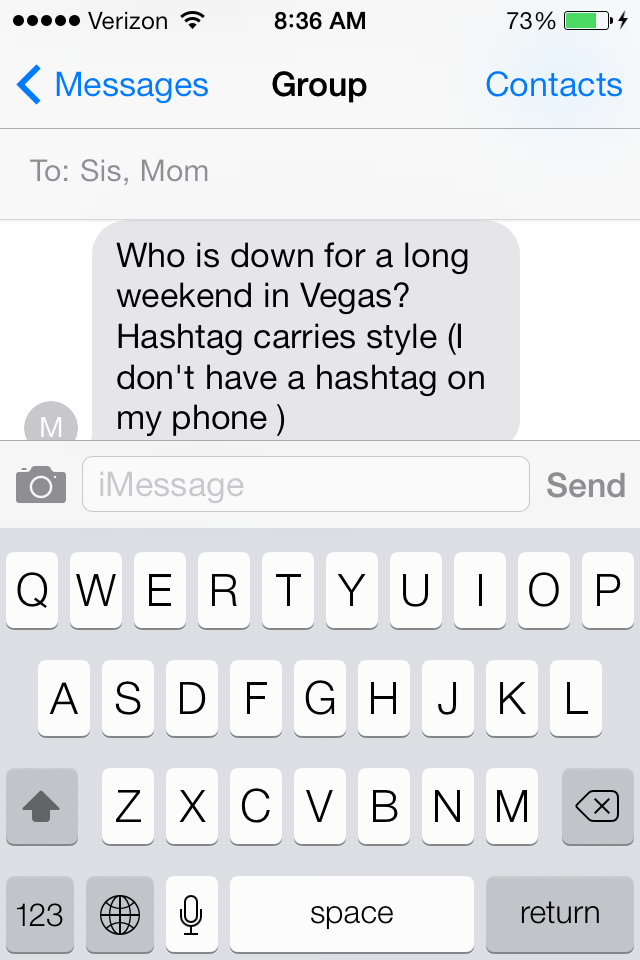
Real text from my mom:
2015-05-05-1430860759-134607-IMG_2477.PNG

吃斋的猪

猪现在的三餐多是吃蔬菜瓜果类。 偶尔蔬菜碗中加几片薄薄的肉片或鸡蛋增添点滋味。 吃素吃多了脸色也绿黄绿黄的。 本来都正在步入中老年人的步伐,脸色已经非常灰暗了,再加上营养不均匀的三餐。 猪脸越见丑陋,自己都不想看到镜中的自己。 这样的伙食也使猪脚步乏力,整天缺乏动力。 只想躺着不...