We’re taught that giving is superior to receiving. Indeed, the art of giving is a helpful corrective to human narcissism. Seeing what others need to be happy requires empathy and kindness.
But receiving is an equally noble endeavor.
We may strive to love, but to what extent to we allow ourselves to be loved? When
someone extends attention and caring toward us, how deeply do we let it
in? Can we allow ourselves to be nourished by another’s kindness?
Receiving deeply provides needed nutrients for our soul, while also
honoring the giver—making them feel that they've made a difference in
our life.
Being mindful of the following might deepen your capacity to receive, thereby bringing greater fulfillment to your life: Get Out of Your Head and Be Relaxed in Your Body
When someone does us a favor or compliments us, we might feel awkward or shy, or not know how to respond. We might think we’re required to reciprocate. We might wonder: Must I now do them a favor or compliment them? Are they expecting something in return? Do I really deserve this kindness? Such thoughts keep us imprisoned in our head. Negative self-talk keeps us depressed, disconnected, and unhappy.
The next time someone gives something to you, see if you can take a deep breath and let it be. Relax. Don’t trouble yourself by trying to figure it all out. Don’t overthink it. Just let it in.
The trick is to get out of your head and stay in your body. How do you feel in your stomach and chest to be gifted with such kindness? If thoughts are swirling, simply notice them and set them aside. Don’t Question Whether You Deserve It
Sometimes we don’t absorb good stuff because we think we don’t deserve
it. We might think, “If they really knew me, they wouldn’t say this.”
Or, “I haven’t done much for them, so I don't deserve this favor.” It’s
easy to drive ourselves nuts with endless considerations. Lost in the
folds of our thought process, the beauty
of the gift slips out of our hands. The giver might notice our
distraction and not feel appreciated for what they’ve done for us.
We can drive ourselves crazy pondering whether we deserve something.
Who’s to say whether we do or don’t? Does it really matter? It’s
unlikely that the giver has evaluated whether we deserved it, so why
should we? Perhaps it was a spontaneous act of kindness that felt good to the giver.
Questioning it diminishes the power of the offering.
An important part of self-worth is to validate that it’s OK
to receive things. Being human means having needs and wants, which
includes being valued and appreciated. No doubt, we have ample flaws and
limitations, but when we're given a gift is not the time to ponder
them—actually, one of our flaws may be that we complain that nobody
cares about us despite evidence to the contrary. We’re not skilled at
the art of receiving good stuff when it comes our way.
When someone gives you something, it's a good time to let your mind be quiet and just focus on receiving. Allow Yourself to Be Vulnerable
We’re firmly in control when we give, but not when we receive. Being
the recipient of a kind word or deed can trigger a sense of
vulnerability. Receiving requires the strength to be vulnerable.
When a tender moment arises during a conversation—perhaps a look of compassion as we talk about a parent’s illness—can we let someone's tender caring in or do we quickly look away due to shame or embarrassment?
How often do we voice our struggles, hoping to find a kind and
receptive ear, and then when someone offers a kindhearted response, we
keep talking over it?
Allowing ourselves to slow down and welcome a tender vulnerability
can be connecting—a salve for our isolation. Taking a moment to pause or
show a tear can be a gift to the listener. It can signal in ways deeper
than words that their caring has touched our heart and helped us take a
small step toward healing.
Look for opportunities to let love and kindness in when it comes your
way. It might be as simple as someone holding open a door for you, or a
genuine interest in hearing about something that’s troubling you, or a
warm hug. As you practice being a sponge, you may allow more joy into
your life.
And as your emotional tank gets filled, you’ll have more to offer others.
We all have something to work on. Here's how to start.
Posted May 26, 2015
In the 11th edition (2015) of Kaplan and Sadock’s text, Synopsis of Psychiatry,
six qualities are considered “mature defenses,” or qualities of a
psychologically well-off person. While most of us harbor some neurotic,
immature, or narcissistic tendencies, we can focus on the following traits to cultivate a well-lived and healthier life:
People with a modicum of these qualities meet demands while
satisfying personal needs. They are adaptable, resilient, and can take
on challenges and form solid relationships. (Good relationships are the
greatest contributor to contentment, according to Sadock and Kaplan.)
In psychoanalysis, we distinguish life goals, such as a particular career, from psychological goals, such as greater resilience.
The hope is that a strengthened psyche (internal life) will breed a
better external life. Development of “mature defenses” is useful both
psychologically and practically. Who you are motivates what you do,
achieve, and acquire, whether a position or a person to love. Though much of disposition is innate, inherent tendencies can be honed and existence-enhancing behaviors learned.
These characteristics foster a more harmonious way of living,
interpersonally and otherwise. Happy moments are more frequent when you
are psychologically fortified. Altruism, anticipation, asceticism,
humor, sublimation, and suppression foster positive outcomes and even
inner peace.
With these traits, the chance of success in work and love improves. Freud said that meaningful work and love are the basis of mental health. Dr. Martin Seligman, the father of Positive Psychology, found that character
predicts success more than test scores. I posit that a healthier,
happier person is more likely to give, create, and contribute when the
"inner equipment" is refined.
Let’s look at the six qualities more closely. Altruism. Self-sacrifice is healthy unless you deplete yourself or become resentful. This latter situation, called “altruistic surrender,” can be a masochistic choice and cause more harm than good. Your exhaustion and your subject’s guilt are non-deal outcomes.
Tip 1: Understand where to draw the line between giving and surrendering.
Anticipation. Anticipation steadies and readies. Healthy pessimism
is a positive quality. Considering what could go wrong prepares
you both psychologically and practically. Blows, setbacks, obstacles,
and competitors won't blindside you. Although optimism can motivate, and negativity deflate, blind optimism leads to hard falls.
Tip 2: Stay the course with confidence, awareness, and good reality testing.
Asceticism. “Gratification is derived from
renunciation.” Self-mastery is empowering. The ability to resist
temptation was studied in the famous Stanford Marshmallow Test. Young
children were told that if they did not eat a marshmallow put in front
of them they would get two later. Those that delayed gratification
turned out to be more successful adults. Asceticism is often associated
with religion, but psychologically speaking, it represents the self-control that conjures happiness. This is not to say that indulgences are not necessary; they are.
Tip 3: The bottom line is to balance the pleasure principle (hedonistic drive) and the reality principle (ability to assess circumstances and choose discomfort to achieve a superior result.)
Humor. “Humor allows one to bear, and yet focus on,
what is too terrible to be borne, in contrast to wit, which involves
distraction or displacement from the affective (emotional) issue.”
Tragedy and comedy can stem from the same source. Humor is a way to deal
with a problem while staying connected to the source of pain, whereas
wit can be an attempt to dismiss or detach from it.
Tip 4: Be with a person who makes you laugh
because this provides both connection and distraction. You may have to
sit in the sadness for a while, but that is far better than fighting it.
In order to be free from heartache, you first have to feel it. Denial
interferes with moving on because your energies are used
(unsuccessfully) to battle truth rather than accepting it, working
through it, and letting go.
Sublimation. Sublimation involves channeling raw
instinct into refined production. Powerful energies that might otherwise
cause chaos or destruction are directed into positive situations,
people, projects, or goals. Trying to repress or rid intense drives, can
lead to torturous inner states and uncomfortable symptoms, such as
anxiety.
Tip 5: Know and accept what is in your
core and employ it rather than running away. Follow your
passion/desire/wild side, but direct it, rather than letting it direct
you.
Suppression. Sometimes you have to put things on the
back burner. Suppression is different from repression in that the
matter is within reach of consciousness but is not immediately
addressed. It floats about in the back of the mind. The ability to hold
back and live with the niggling discomfort of non-resolution is a skill.
Suppression allows for the ripening of the solution. Sometimes you just
can’t deal with it right now—and it is better that you don’t.
Tip 6: Wait until the solution comes to
you rather than taking premature action, which can interfere with a
natural course and a desired result. Timing matters. Also, if something
is too overwhelming, maybe you should wait till you have support.
Everyone has something to work on, psychologically speaking. We all
have healthy and less healthy qualities. If change interests you, here
are 6 More Tips for Psychological Change:
Gather insight
Be curious
Practice rational self-critique
Get comfortable with discomfort
Remove unnecessary guilt
See which of the six traits are already within you and build upon them. Starting with a fragment is just fine
Source: by Chloe Barron
As far as healthy traits go, I would add self-knowledge. Good-fit decisions (choices that best match the healthier side of your authentic personality) with regard to work, love, school, community, and environment can elude you if you are not self-aware. Insight protects, saves, liberates, and even leads to happiness.
Research into the surprising connections between pet ownership and sex appeal.
Posted Nov 09, 2015
Can your dog or cat boost your sex appeal?
In a 2008 experiment, two French social psychologists had a handsome
young Frenchman named Antoine approach 240 randomly selected women and
ask them for their phone numbers so they could go on a date. (See more here.)
The catch was that half the time Antoine was alone and half the time he
was accompanied by a cute little grey dog named Gwendu.
Did the dog improve Antoine’s hit rate? Absolutely!
When he was alone, only 10% of the women gave Antoine their phone numbers, compared to 30% when Gwendu accompanied him.
Do pets really affect the dating
strategies of today's singles? Do men use their pets for date-bait? Are
women more attracted to men who adopt a rescue dog? What happens if
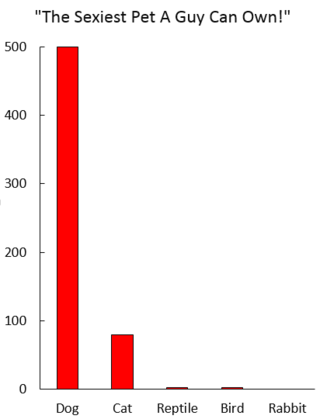
your pet does not like your date? And what is the sexiest pet?
These and other questions about the impact of companion animals on
modern romance were asked—and answered—in an innovative study which will
appear in a forthcoming issue of the journal Anthrozoös.
The research team was led by University of Nevada-Las Vegas anthropologist Peter Gray. (See his terrific Psychology Today blog The Evolving Father.) They tested several hypotheses about pets, contemporary courtship, and dating rituals. A cardinal tenet of evolutionary psychology
is that women tend to allocate more resources to child rearing, while
men devote more time and energy to mating. Thus the researchers
predicted, for example, that women should be more sensitive than men to
how their dates treat their own dogs and cats. Men, on the other hand,
should be more likely to use their pets to attract sexual partners. Gray
and his colleagues also predicted that when it comes to signaling the
qualities of a date as a potential parent,
interactions with dogs would provide more salient cues than those with
cats, because dogs are generally thought to require more care and
attention. The researchers also investigated intergenerational
differences in the roles pets play in dating. Finally, they tossed in a
couple of questions for fun—for example, asking female subjects, “What
is the hottest pet a guy can own?” Match.Com: A New Source of Research Subjects
Source: Graph by Hal Herzog
In collaboration with the pet store chain PetSmart, the researchers recruited 1,210 single pet owners through the online dating
service Match.com. In the pool of participants, 60% were women and 40%
were men; 72% were dog owners and 42% cat owners. The subjects took a
21-question online survey about how pets entered into their dating
lives.Here are some of the highlights:
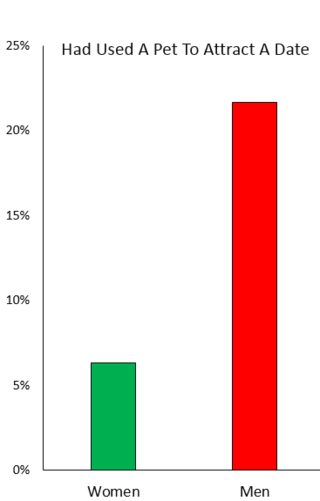
22% of the men—but only 6% of women—admitted they had used their pet to attract potential dates.
35% percent of women and 26% of men said they had been more attracted to someone because they owned a pet.
Nearly half of the women and a quarter of the men said they judged dates based on how the person responded to their pet.
76% of women and 60% of men evaluated dates based on whether their own pets like the person.
64% of women and 49% of men said they were more attracted to a person if they owned a rescue animal.
75% of the women and 54% of the men said they would not date someone who did not like pets.
Are Millennials Different?
Source: Graph by Hal Herzog
During a panel discussion on cats as pets at the recent Better with Pets Summit (link is external), Purina
scientist Sandra Lyn argued that the millennial generation has
different relationships with their pets than baby boomers. The results
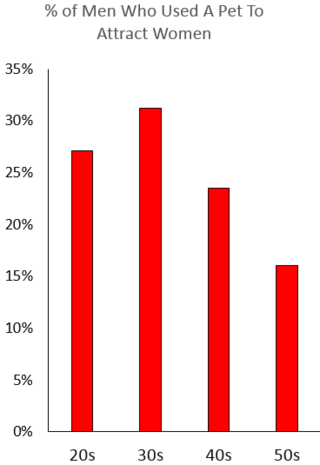
of the Match.com study suggested she is right. As shown in this graph,
men in their 20s and 30s were more likely to use their pets as
"date-bait" than older singles. Millennials said they were particularly
attracted to pet owners and more willing to evaluate dates by how their
dogs and cats reacted to the person. Millennials were also more likely
to find pictures of pets posted on online dating profiles a turn-on. Pets, Dating, and Evolutionary Psychology
Finally, the researchers’ hypotheses about gender
differences in the use of pets as signals of mate quality were
confirmed. As predicted, women were more discriminating than men on
eight of the 11 questions related to the use of pets in evaluating
dating partners. (There were no gender differences for the other three
questions.) Dog owners were more likely than cat owners to use pets as
indicators of a date’s attributes: For example, more dog people than cat
people said the responses of their pet to a date was important. Dog
owners were also more likely to say that the way a date treated their
own pet mattered and to believe that person’s pet revealed a lot about
their personality.
Bringing
up daughters is complicated: Empowerment messages and impressive
achievements are everywhere, yet depression and anxiety are very real
threats. This is how to help your daughter become her best, well-rounded
self in spite of it all.
During a walk home from school not long ago, my first-grader
was pretending to chat on the phone. I asked whom she was “talking” to
and when she replied “My boyfriend,” I immediately got that feeling. It
was the same foreboding knot that I felt in my gut when I recently let
her 4-year-old sister pick out a new coloring book and she (once again)
chose the sparkly “fashion girl”
one. While there’s nothing inherently wrong with my kids’ behavior, I
know exactly why it triggers my anxiety. It’s rooted in what I know as a
woman, which is that seemingly innocuous things—talking to a boy,
beauty, and appearance—have the potential to become thornier issues as
my girls get older. I love having daughters. I honestly feel like I was
born to parent girls, which is why nothing annoys me more than someone
doing the whole “Ooh, two girls? You are so in for it!” thing. But it
can feel like walking a tightrope. On the one hand, I’m thrilled for
their future. Women are graduating with more advanced degrees than ever
before and have more female role models in just about every public
sphere you can think of. Empowering ad campaigns such as Always’s “Like a
Girl” series go viral in minutes.
Unfortunately,
all of this high achievement comes with a downside. “It’s true that
girls are doing great on paper, but when we look at what we call the
‘internal résumé,’ we don’t see the same success story,” says Simone
Marean, cofounder and executive director of Girls Leadership, a national
nonprofit serving girls in grades K–12, as well as their families and
educators. While girls’ levels of academic achievement have risen to the
point that they now outperform boys consistently, their rates of
stress, anxiety, and depression have risen as well. A study by the
Substance Abuse and Mental Health Services Administration found the
girls to have three times the number of depressive episodes as the boys,
and the rate at which girls reported feeling depressed nearly tripled
in just one year. In other words, while girls are doing everything
possible to be all that they can, they’re not enjoying it. And this
“wellness gap” is what parents and teachers need to focus on, says
Marean. Like you, I want my daughters to have boundless opportunity. But
more than that, I want them to be happy—and a big part of that means
making sure that they're ready for whatever challenges they’ll someday
face. In that spirit, I spoke to some of the biggest change-makers in
our country—people who are leading the charge to make sure girls enter
adulthood feeling good about themselves—to find out what parents can do
to help their daughters thrive. Now I’m sharing what I learned.
Above All, Know Your Impact
Melanie AcevedoIt
can be easy to forget that parents, particularly mothers, are a
powerful inf luence. Even teenagers, whom we assume are easily swayed by
peer pressure, say that their mom matters most: 63 percent of girls who
report that they have a role model say it’s their mom, and 48 percent
turn to their mother for support when they have a problem, according to a
survey of nearly 1,100 girls ages 13 to 18 by Keds and Girls
Leadership. Only 15 percent go to their friends first for advice.
Younger girls are even more reliant on Mom: “Gradeschoolers may get into
the mix with their friends during the day, but their mother is the safe
haven,” says Robyn Silverman, Ph.D., a parenting expert in Morris
County, New Jersey, who presents workshops on how to raise confident
kids. Chances are you’re everything to your daughter—including her
biggest role model. Report after report finds that the way a mother acts
in front of her daughter largely influences the child’s behavior, and
there are ways to model a healthy self-image that benefit both of you.
First, watch what you say, especially gossip.
“Bullying doesn’t
stop after childhood,” says Stacey Radin, Psy.D., coauthor of Brave
Girls and the CEO and founder of Unleashed, a nonprofit for adolescent
girls in New York City. “So-called ‘mean girls’ grow up, and how you
treat other people—or talk about them—is a good predictor for how your
daughter will too.” And it’s not just what you say, but how you say it.
“Women often speak in questions or begin with a caveat like, ‘I’m not
sure this is right, but ... ,’ ” points out Rachel Thomas, president of
LeanIn.org, the organization that created the Ban Bossy campaign with
the Girl Scouts to encourage leadership. “Speak with conviction and
encourage your daughter to do the same. My 8-year-old uses baby talk
when she’s unsure about something, and I remind her that she has
important things to say and people may not take her seriously if she
uses that voice. Even at LeanIn.org, we call one another out for
secondguessing ourselves when we speak.” The unsaid things you do matter
too, particularly things related to body image, since research shows
that how a girl feels about her appearance is largely determined by how
her mother regards her own. In a recent United Kingdom Dove survey of
2,000 moms, girls as young as 7 were reported to mimic moms’ behaviors
like sucking in their stomach or describing themselves as fat.
One
way to flip the script? Get active. When your daughter sees you go out
for a run, or you dance in the living room together or help her scale a
rock wall at the playground, you’re teaching her to love her body.
Finally, as important as Mom is, the significance of Dad or a father
figure can’t be understated. Meg Meeker, M.D., author of Strong Fathers, Strong Daughters,
says that girls take cues from the men in their lives from the time
they’re little, and the attention they receive (or not) influences
everything from seeking boys’ approval to finding their career path. “In
my experience, kids typically believe that Mom’s love is nonnegotiable
and expected,” says Dr. Meeker. “But for whatever reason, Dad’s love is
not the same, even if he’s a great dad, so it’s powerful when he
communicates to his child that he loves her.” Dads should praise their
daughters’ character rather than solely compliment their appearance.
“When you mention how patient she is with a younger sibling, for
example, it shows that you see who she is,” says Dr. Meeker. One-on-one
time is crucial: “Lots of dads, and particularly single or divorced
dads, think that an outing with their daughter needs to be sensational.
But pulling her into the menial—grocery shopping together, washing the
car—shows that you value her company in the context of your life.”
Help Her Feel Unique
Melanie AcevedoAll
right, brace yourself: Between elementary and high school, a girl’s
self-esteem drops 3.5 times more than a boy’s does, found the American
Association of University Women, a national organization dedicated to
improving the lives of women and their families through advocacy,
education, philanthropy, and research. The antidote? Encourage your
young daughter’s individuality, and you’ll lay a foundation that will be
her emotional scaffolding as she enters the trickier tween and teen
years. “Adolescence is when girls truly start to understand their
identity as separate from their parents, so they will experiment with
various types like the ‘class clown’ or the ‘renegade,’ ” explains Dr.
Radin. “But if they already have a strong sense of self, they have a
much easier time navigating adolescence.”Cast a wide net when
encouraging your daughter to discover her passions. During a trip to the
library, don’t nudge her toward Pinkalicious. Even if she’s the
girly-girl type, who’s to say she wouldn’t also love a world atlas?
Instead of signing her up for gymnastics because it’s the popular
choice, present a range of options and see what she picks. Once she
shows an interest in something, give her lots of chances to explore it.
It’s key to help her hone her interests when they’re different from the
rest of the family’s. “Some girls have obvious gifts, but others (like,
say, the child who isn’t so coordinated in a family of natural athletes)
need help drawing them out,” says Dr. Silverman. “I once worked with a
soccer-player mom whose daughter had no interest in the sport, but she
loved swimming and flourished once her mom put her on the swim team. It
seems obvious, but it can be hard for moms when they aren’t the
mentor. Instead, realize that sometimes you’ll be the bridge who
connects your daughter to the expert.”
Praise Her Imperfection
You
might be surprised to learn that letting your daughter screw up is one
of the best ways to build her confidence. The theory: Girls are
inadvertently groomed to become perfectionists by being praised for
“good girl” behavior, so they quickly learn that making mistakes means
“not good enough.” This becomes problematic because researchers have
found that it’s the very process of taking risks and messing up that
builds confidence, explains Katty Kay, lead anchor of BBC World News
America and coauthor of The Confidence Code. “We tend to make our kids’
lives easy by doing things for them because we’re so desperate for them
to succeed. But then when you tell a child she can do ‘anything,’ she
has no evidence to support that because she hasn’t had to work hard at
anything,” says Kay. Show your daughter that mistakes are a normal part
of life. Speak up (often!) about your own missteps, even when it’s
something as minor as dropping your phone, and give her opportunities to
make little flubs. Kay calls these “frying an egg” tasks: “Make a list
of small things you can teach her to do on her own, like frying an egg.
The process of learning through trial and error will build her
confidence.” Or try something new together—a baking experiment, a
martial arts class— where you can “mess up” together for the fun of it.
Instill Social Confidence
Melanie AcevedoRight
now, the highlight of your kid’s social life is being the line leader,
but tough social situations start earlier than you think. Research from
Penn State Erie, The Behrend College shows that on average, half of kids
and adolescents, a disproportionate number of them girls, experience
“relational aggression” (when kids intentionally exclude a child or
coerce other children to leave someone out) at least monthly from grades
5 through 12. Even more troubling: A State University of New York at
Buffalo study shows that the behavior starts in kids as young as 21/2.
“Conf lict is inevitable in a kid’s life,” says Rosalind Wiseman, author
of the best-selling book Queen Bees and Wannabes. “And for that very
reason, you need to teach your daughter how to handle it.” Showing her
that it’s okay to express a full range of emotions is the number-one way
to do this. “Because girls frequently show a lot of emotion, we
mistakenly believe that they are emotionally intelligent,” says Marean.
“But girls learn very early to take care of other peoples’ emotions
first. They think they are always supposed to feel happy and excited,
and they push down so-called ‘bad’ feelings like jealousy, anger, or
insecurity.”
U.S. Senator Kirsten Gillibrand (D-NY) expands on
this. “Emotions are an incredibly powerful tool, and we need to teach
moms and girls that when you feel angry or upset, it’s a signal that
something is important to you, and you should express it,” says Senator
Gillibrand, who credits her grandmother and her mother with teaching her
how to make her voice heard. Normalize anger, first of all, by telling
your daughter about the (kid-appropriate) things that have upset you.
With young children, look for opportunities to build their emotional
language, says Marean: “When you’re reading a book or playing with dolls
or stuffed animals, ask, ‘Why does X feel this way?’ or ‘Do you think X
needs a hug?’ ” When your daughter runs into trouble socially—let's say
she’s not invited to a birthday party—don’t shrug it off and insist
it’s not a big deal. This only communicates that her feelings aren’t
valid. The same goes when boys are involved: “I can’t stand when parents
tell their daughter that a boy is being mean to her because he likes
her,” says Wiseman. “It sets a terribly unhealthy precedent by teaching a
girl that being treated badly means the person likes her and therefore
she should accept the behavior.” Instead, discuss it. (See “Boost Her
Social Skills” on page 104 for tips.) Consider getting your daughter
involved in a group, whether it’s a sports team, Girl Scouts, or friends
who get together for a weekly art class. Girls are especially likely to
express independence and pride when they’re working with other kids on a
common goal, even if it’s as simple as making a collage, says Dr.
Radin. Team sports can be particularly beneficial for girls because
winning and losing teaches resilience. In fact, in a recent online
survey of 400 female executives worldwide, a full 94 percent of them had
participated in sports, and 74 percent said that they had influenced
their career potential. Finally, as trite as it may sound, for all the
challenges a girl may face and all the effort you put into helping her
find her way through them, there is nothing more grounding or powerful
than your unconditional love. “More than anything, kids need to know the
answers to three things,” says Dr. Meeker. “What do you think about me?
Do you understand me? What are your hopes for me?” Express those to
your girl, and her future will be brighter than ever.
It’s
not just women who have their ‘time of the month.’ Indeed, men’s
hormonal shifts fluctuate dramatically day-to-day. One expert calls it
Irritable Male Syndrome (IMS).
Is
your man irritable? Does he growl at you if you dare to take a piece of
the chocolate bar that he is eating, or seethe a little too angrily at
the loss of the TV remote? Well, understand that maybe it’s his time of the month.
A quarter of British men believe they have ‘man periods,’ according to a new survey, reported by The Telegraph.
The poll of 2,412 people, commissioned by vouchercloud.com,
made up of half male and half female respondents, revealed that 26
percent of men experienced conditions associated with the female
menstrual cycle, including tiredness, cramps, and increased sensitivity.
Almost half the women surveyed—43 percent—said they helped their men through their ‘man period’ symptoms.
On
how they attempted to do this, women showed themselves to be as lacking
as men sometimes feel around their female partners. “Try and cheer him
up” summed up the modus operandi of 44 percent of women with man-period
suffering partners, while “walk around on egg shells” accounted for how
39 percent dealt with it.
Of the men suffering from ‘man periods,’ 56 percent said they were
irritable, 51 percent said they were more tired than normal, 47 percent
had increased cravings, while 43 percent said they were both constantly
hungry and easily upset. The Telegraph
reported that 12 percent said that they were “more sensitive about
personal weight.” Five percent reported even suffering from “menstrual
cramps.”
The man who describes himself as suffering from man periods will
spend an extra £81.53 a month (about $124.72) on purchases to satisfy
his food cravings than a man who does not.
Not all of Britain’s households are in a state of multi-sexual,
crampy sensitivity—or maybe it’s that a sizeable number of women simply
don’t have the patience for these male ‘times of the month’: 33 percent
of women who didn’tbelieve in the existence of the ‘man period’ had told their partners to ‘man up.’
As funny it all may sound, the ‘male period’ may be a very real,
medically recognized phenomenon—albeit without the definitive monthly
period bleed that women go through.
Professor Peter Schlegel,
chairman of Urology at New York-Presbyterian and Weill Cornell Medicine,
told the Daily Beast that while women “have very regular hormone cycles
and there are obvious symptoms
attached to them, men also have extraordinarily similar hormonal
changes on a daily basis. Testosterone levels in younger men can vary
four-fold in a typical day. What is less clear is how those levels vary
day by day and week by week.”
While testosterone levels decline with age, Professor Schlegel said
men with their doctors should judge if those levels had decreased to an
abnormal level, deleteriously affecting their sex drive, behavior and
mood, before seeking treatment.
“The
notion that men can be ‘hormonal’ is seen immediately as a joke. But
the truth is that men have hormonal cycles just like women.”
Jed Diamond, therapist and author of The Irritable Male Syndrome, who is a believer in the “male period,” said that “men have hormonal cycles just as women do.”
Diamond, who also founded men’s wellness site MenAlive.com, says there are two crucial periods when men’s hormones shift: adolescence/young adulthood and midlife.
IMS
is characterized by depression, anger, fatigue, moodiness, anxiety,
lethargy, low libido, and confusion, he writes on his websites, which
“can wreak havoc with a man’s closest relationships.”
Experiencing a
major stressful event can help you deal with the smaller stressors in
your life, according to new research on older adults.
In the new study, published in the Journal of Gerontology: Psychological Sciences, researchers
from North Carolina State University studied 45 adults between the ages
of 60 and 96 and asked them about whether they had experienced a major
stressful event—good or bad—in the last year, such as losing someone
they loved or retiring.
The researchers then asked the men and women about their daily
stressors over an eight day period. In order to gauge their general
sense of well being and vitality, the team also asked the men and women
to rate how old they felt, how old they would like to be and how old
they thought they looked that day.
“There’s a lot of research on how old you feel,” says study author
Jennifer Bellingtier, a Ph.D. candidate at North Carolina State
University. “When you feel younger you have better mental health, tend
to live longer, and have better well being.”
Interestingly, the researchers found that the men and women who had
experienced a major stressful event in the past year were overall less
upset by smaller daily stresses. The people who had not experienced a
major stressor were more likely to feel much older on a stressful day
whereas those who had dealt with a stressful event didn’t change much in
their opinions of how old they felt. “We found they seemed to be less
perturbed by everyday stress,” says Bellingtier.
All of the people in the study reported that they thought they looked
around 10 years younger than they actually were. But on stressful days,
those who had undergone major stress in the past thought they looked 20
years younger while people who hadn’t experienced a major change were
more likely to say they looked their actual age.
While the study involved only a small number of people, Bellingtier
says the findings may teach us important lessons about the value of
surviving and coping with major life changes. The results suggest that
as difficult and traumatic as they can be, stressful experiences can be
sources of strength from which people can draw during future trying
times.
“I think in some sense it means we can learn from our major life
stressors and it can be beneficial to us,” she says. “It’s easy to get
caught up in a lot of little daily things. It can be useful to know I’ve
gotten through a lot more.”
What's the worst that can happen? It's probably not as bad as you think.
Posted Oct 29, 2015
Insecurity kills more dreams
than lack of talent does. Believing things like "I'll never get
promoted," or, "I can't compete with her" will turn self-doubt into a
self-fulfilling prophecy. All of us feel self-doubt sometimes, no matter
how confident we are. But, mentally strong people don't let self-doubt prevent them from reaching their goals. Here's how to keep self-doubt from holding you back. 1. Embrace (a little) self-doubt.
Don't worry about a little bit of self-doubt: Slight insecurity could
actually bolster your performance. A 2010 study published in Psychology of Sport and Exercise (link is external) found
that individuals who experienced a little self-doubt actually performed
better compared with people who were completely confident in their
skills. Other studies have found similar results.
So rather than waste energy worrying that your self-doubt is actually
a sign from the universe that you're about to fail, recognize that
self-doubt can be helpful. Perhaps you'll spend more time rehearsing
or put in more effort when you're aware that there's a chance it might
not go so smoothly. 2. Question the evidence behind your thoughts.
When you encounter serious self-doubt, examine the truth behind it.
Ask yourself, "What evidence do I have that I can't do this?" Then ask,
"What evidence do I have that I can do this?" Go ahead and write down your answers on a piece of a paper.
Looking at the facts can help you see things in a more realistic way.
This exercise may not eliminate all of your self-doubt, but it can help
reduce your insecurities to a more manageable level. 3. Consider the worst-case scenario.
Self-doubt is fueled by catastrophic predictions: "I'm going to mess
everything up." "I'll never get another chance." When you find yourself
guessing things will go poorly, ask, "What's really the worst thing that could happen?" If you do make a mistake, would it really be that bad?
Remind yourself that even if things go terribly, it's unlikely truly
to be life altering. A few years from now, losing a game, stumbling over
your lines, or failing to get a promotion probably won't matter that
much. Keeping things in proper perspective can help you calm your
nerves. 4. Monitor your emotions.
Your emotions play a major role in how you think and behave. Anxious
feelings can fuel doubtful thoughts and impair your performance, unless
you take steps to regulate your emotions.
Pay attention to how your emotions influence your choices. If your anxiety skyrockets,
calm your body and your mind by taking deep breaths, going for a walk,
or distracting yourself with mundane tasks. Don't allow short-term
discomfort to convince you to bail out, give up, or cave in. 5. Focus on your present performance.
Whether you're stepping on a stage or running out onto an athletic
field, telling yourself, "I'm going to embarrass myself" will only
distract you from your performance. Rather than allow your inner
monologue to drag you down, stay focused on the present.
Before you take the giant leap into whatever you're feeling doubtful
about, give yourself a quick pep talk. Saying "All I can do is my best"
will remind you that you don't need to strive for perfection. With that reminder in mind, you'll be better equipped to put your energy where it needs to be—on your performance.
 狀況一:老闆安排我跟討厭的同事共同合作完成項目,好不情願。
 We’re taught that giving is superior to receiving. Indeed, the art of giving is a helpful corrective to human



 Insecurity kills more